A forged fitting carries the same pressure as the pipe it joins, which is why the forging process matters more than most buyers assume. Every socket, thread, and bore starts as a solid billet and ends as a component that must survive steam, acids, and thermal cycling for decades. Understanding how an alloy steel f1 forged fittings manufacturer builds that strength into each part helps engineers specify with confidence. Here is how the process actually works, stage by stage.
What Are Alloy Steel F1 Forged Fittings?
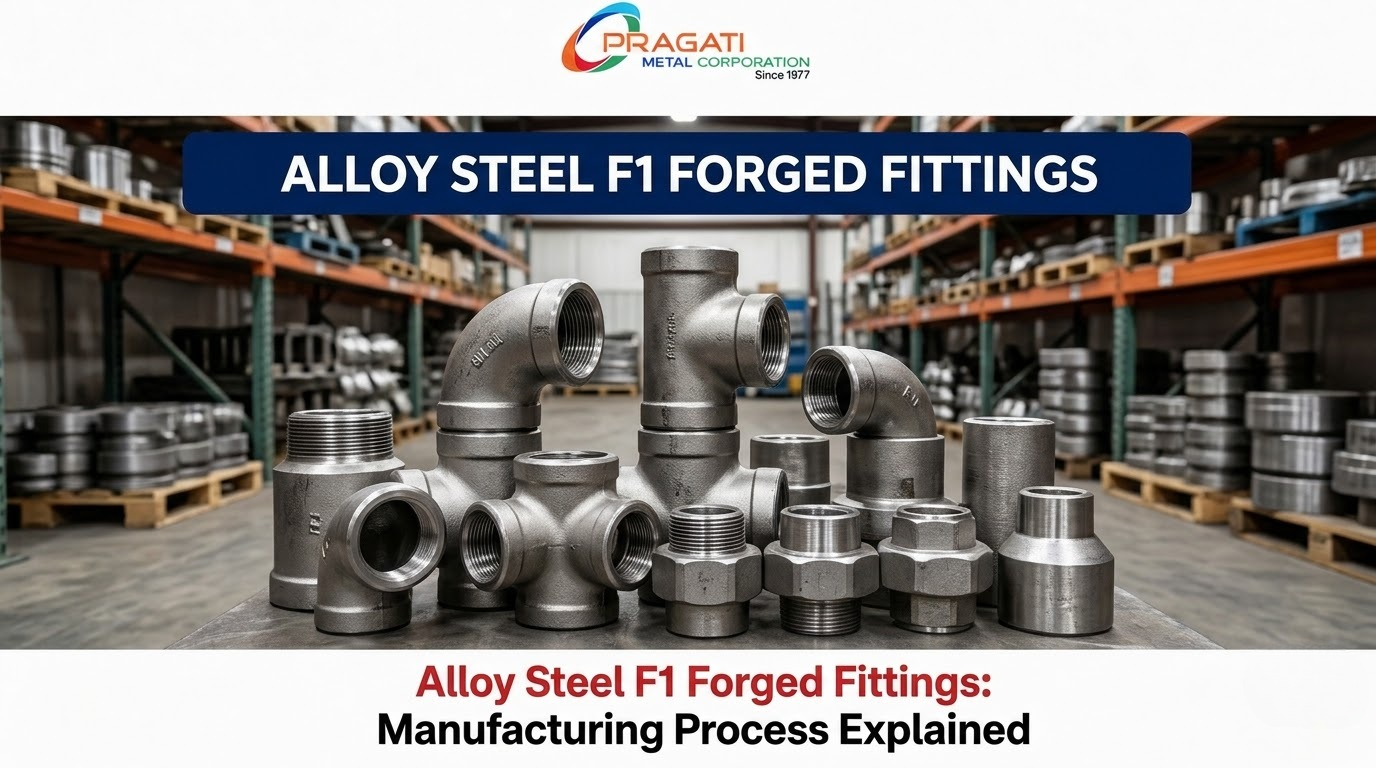
Alloy steel f1 forged fittings are compact, high-strength connectors shaped from solid alloy steel stock. The F1 designation points to a specific low-alloy chromium-molybdenum grade suited to moderate-temperature pressure service. These fittings link, redirect, branch, and terminate flow inside piping that runs at high pressure. Common types include elbows for direction changes, tees and crosses for branch lines, couplings and unions for connections, and pipe nipples for short extensions. Plants across oil and gas, refining, and chemical processing rely on them wherever threaded or socket-weld joints face demanding service conditions.
Manufacturing Process of Alloy Steel F1 Forged Fittings
Raw Material Selection and Inspection
Every incoming billet has a heat number that connects it to a mill certificate. We verify chemical composition to grade and confirm traceability. Where material specification requires, we apply ASTM A182 / ASME SA182 requirements.
Heating and Forging
Billets are heated to a controlled forging temperature, then dies deform the softened steel into the fitting shape under press force. Correct temperature and strain preserve grain flow, and that grain structure directly governs the strength of the finished part.
Heat Treatment
Heat treatment develops the mechanical properties the grade demands, following the cycle specified for Grade F1 rather than a one-size-fits-all routine. The treatment relieves forging stress and sets hardness, tensile strength, and toughness to the required levels.
Machining and Dimensional Finishing
Machining cuts socket-weld or threaded ends, prepares the bore, and cuts threads to tolerance as the design requires. Tight dimensional control and a clean surface finish decide whether the fitting seals and mates correctly on site.
Quality Testing and Final Inspection
Final checks cover chemical analysis, mechanical testing, hardness readings, dimensional inspection, and visual examination. Pressure or nondestructive testing applies only where the specification or purchase order requires it. Before dispatch, each fitting receives its markings, documentation, and traceability records.
Applications of Alloy Steel F1 Forged Fittings
- Power generation plants use them in steam lines and boiler feed circuits subject to design pressure and temperature limits.
- Refineries install them across process piping where material compatibility and code conformity govern selection.
- Chemical processing units apply them in corrosive service lines matched to operating conditions and piping codes.
- General industrial piping systems rely on them wherever pressure, temperature, and media compatibility demand forged strength.
Choosing an Alloy Steel F1 Forged Fittings Manufacturer
A certificate is only as good as the controls behind it. Before you place an order, verify the material test certificate, confirm dimensional compliance against the governing standard, and review the manufacturing and inspection records that prove conformity. Ask how the supplier handles heat-number traceability and what tests they run against your purchase specification. A manufacturer who documents each stage gives you fittings you can install without second-guessing. Pragati Metal Corporation, an ISO 9001:2015, ISO 14001:2015, and ISO 18001:2007 accredited company operating from Mumbai since 1977, manufactures alloy steel f1 forged fittings backed by full certification and four decades of supply to acid, chemical, oil and gas, refinery, and pharmaceutical industries. See our product page for grades, sizes, and specification details.