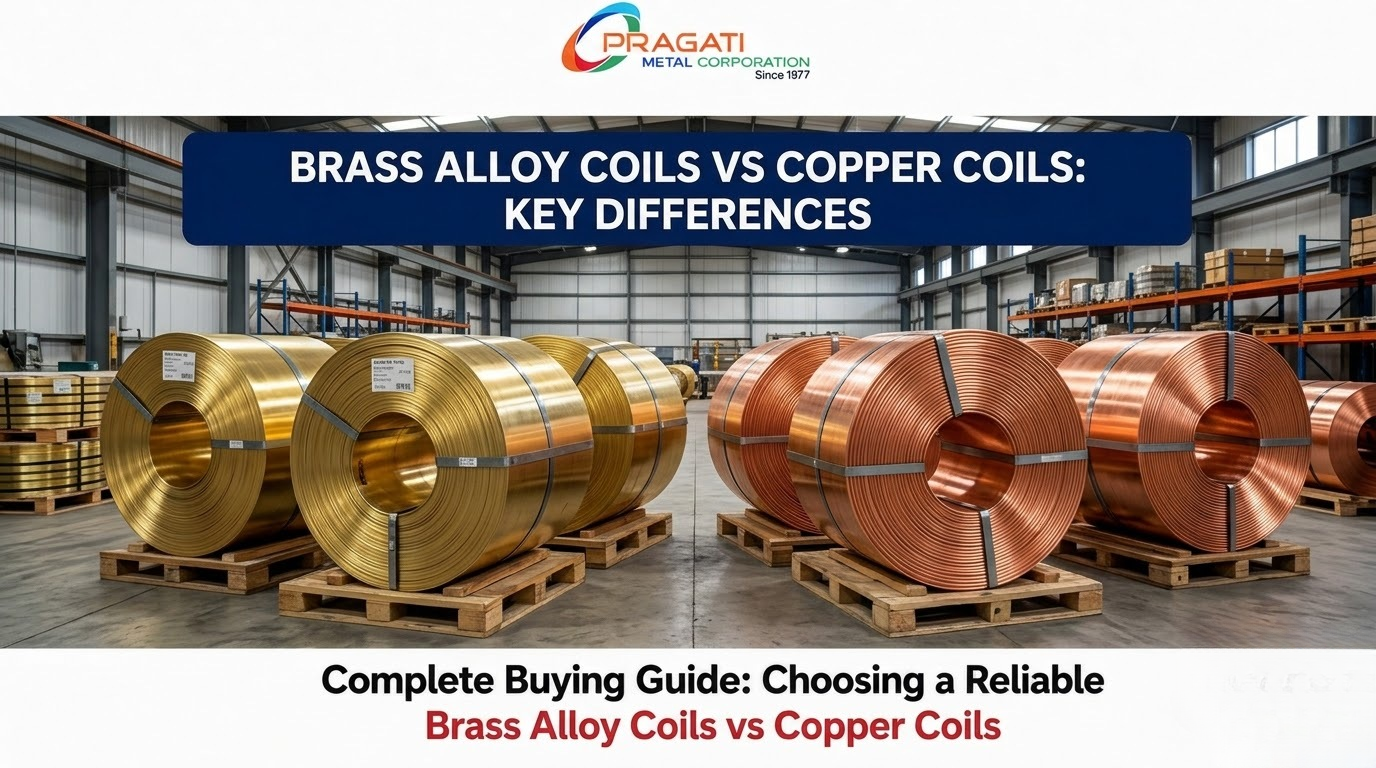
Picking the wrong coil material means you either overpay for conductivity you never use or install a part that fails under load. Brass and copper look similar on a reel, yet they behave differently once you stamp, bend, or wire them into a working assembly. Knowing where each one earns its place saves money and prevents rework. As a brass alloy coils manufacturer serving industrial buyers since 1977, Pragati Metal Corporation sees this decision play out across hundreds of orders every year.
What Are Brass Alloy Coils?
Brass is a copper-zinc alloy, and the ratio between those two metals shapes almost everything about how it performs. Raise the zinc content, and you gain strength and formability. Lower it, and the metal moves closer to copper in conductivity and corrosion behavior. This tunability is why brass covers such a wide job range. Brass alloy coils are supplied in continuous reels that feed directly into stamping presses, roll-forming lines, and fabrication equipment, which makes them a practical starting stock for high-volume component manufacturing. Grades are introduced only where the product specifications support them, since each composition suits a different mechanical and surface requirement.
What Are Copper Coils?
Copper coils are drawn from pure copper or a specified copper grade, with the grade chosen to match the electrical or thermal demand of the end use. Copper carries current and heat better than most commercial metals. That single property drives its dominance in electrical wiring, bus-bar work, transformer windings, HVAC lines, and heat-transfer equipment where conductivity cannot be compromised. Where a design lives or dies on moving electrons or heat efficiently, copper remains the default engineering choice across industrial applications.
Brass Alloy Coils vs Copper Coils: Key Differences
- Composition: Brass is copper plus zinc, and copper coils are copper-based, so their core chemistry dictates every downstream property.
- Electrical conductivity: Copper generally conducts electricity better than brass, making it the stronger candidate wherever current-carrying capacity drives the design.
- Thermal conductivity: Copper moves heat more readily than brass, so heat-transfer-critical parts favour copper while brass handles less demanding thermal duty.
- Strength and formability: Mechanical performance shifts with grade, temper, and manufacturing condition, so neither metal holds a fixed advantage until specified.
- Corrosion resistance: Resistance depends on the exact alloy composition and the service environment the finished coil operates within over time.
- Machinability and fabrication: Brass is another metal that machines nicely in many operations. Both metals are good to form with, given the right temper and tooling setup.
- Cost considerations: Material pricing moves with metal markets, chosen grade, coil dimensions, and order quantity.
Applications of Brass Alloy Coils and Copper Coils
- Stamped components
Brass feeds stamping lines for terminals, clips and small precision parts where the forming behavior is suitable for the tooling.
- Electrical connectors
Brass serves connector bodies and contacts that need moderate conductivity paired with mechanical strength and wear resistance.
- Decorative hardware
Brass works for fittings, trim, and finish-visible parts because its surface accepts plating and polishing well.
- Fabricated parts
Brass handles bending and joining for assemblies where the chosen grade matches the structural demand.
- Electrical conductors
Copper carries current in wiring, bus bars and windings where high conductivity is non-negotiable for the circuit.
- Heat exchangers
Copper is an excellent conductor of heat in tubing and coils used in cooling and thermal systems.
- HVAC components
Copper lines and coils move refrigerant and heat through climate equipment that depends on steady thermal flow. Final material selection always depends on the specific application requirements.
How to Choose the Right Coil Material
Weigh conductivity needs, mechanical strength, corrosion exposure, forming requirements, thickness, temper, and the operating conditions the part will face in service. A connector that must conduct and resist wear points one way. A refrigerant line that must shed heat points another. Always confirm the material grade and full technical specifications before you place an order, because a small mismatch in temper or composition can undo an otherwise sound design. Pragati Metal Corporation supplies brass alloy coils in grades matched to real fabrication and component work, backed by over 40 years of manufacturing and ISO 9001:2015 accreditation. Check our brass alloy coils product page for grade options and specifications before confirming your requirements.
Talk to our team to match the right coil grade and temper to your application.