Specifying a Duplex S32205 round bar means choosing more than a grade. The processing route behind the bar shapes its dimensions, surface, and behavior in fabrication just as much as the chemistry does.
What Do Hot Rolled and Cold Drawn Mean?
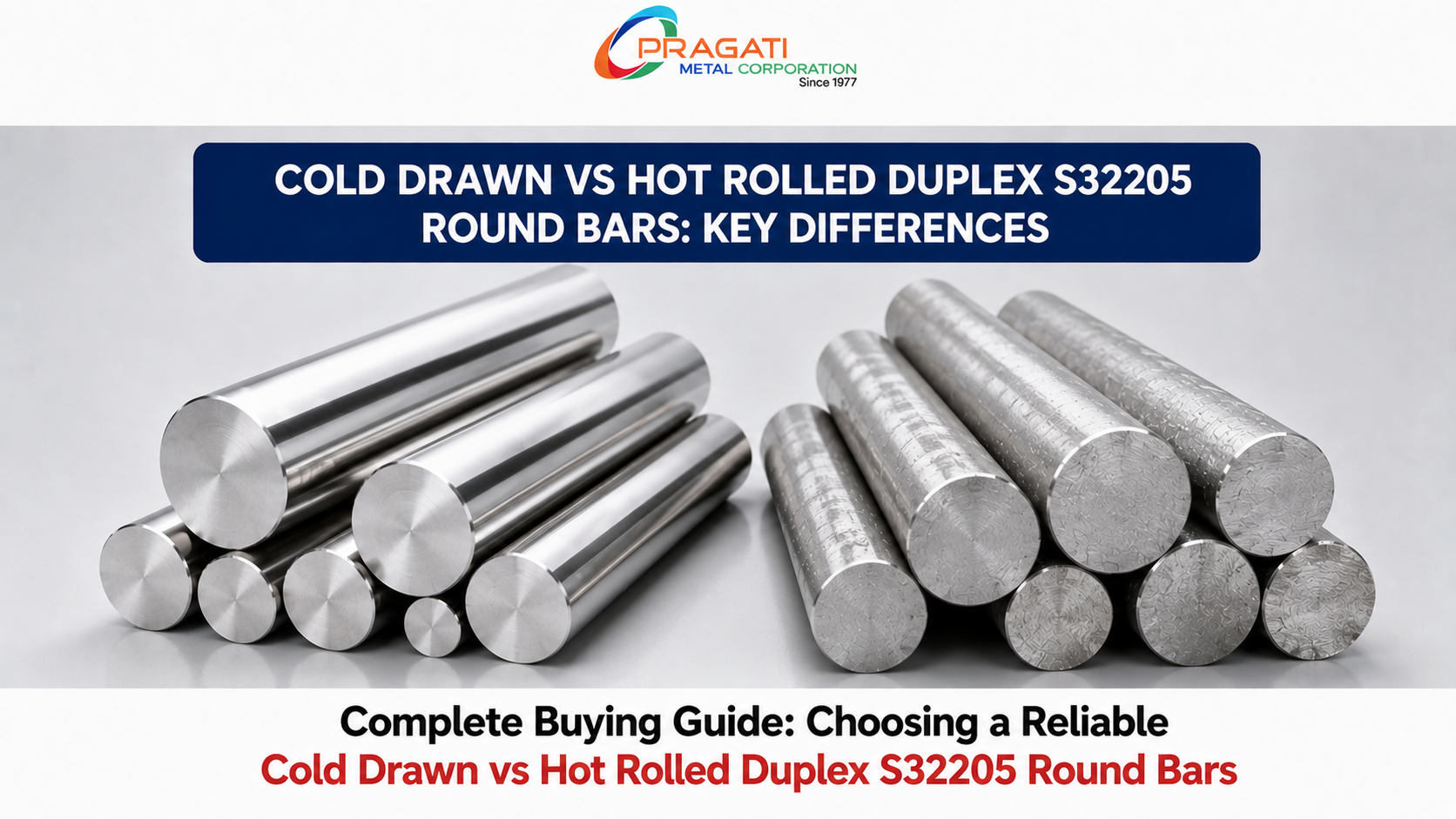
Hot rolling shapes a Duplex S32205 round bar by passing heated material through a series of rollers until it reaches the required round profile. The process suits large production runs and larger diameters, and it leaves the bar in a condition set by the mill’s rolling and finishing practice. Cold drawing takes that starting stock a step further, pulling it through a die at room temperature to refine the diameter and surface. This extra step gives the bar cold-worked characteristics, which can affect the dimensional accuracy and surface finish as opposed to the hot-rolled starting material. The route of the bar is important at the specification stage, as two bars of the same grade, diameter and standard can behave differently in machining, welding or fitting depending on whether they were supplied hot-rolled or cold-drawn. Engineers who specify only the grade and don’t specify the processing condition may receive a material that is not within their tolerance or surface expectations.
Cold Drawn vs Hot Rolled: Key Differences
Both routes start from the same Duplex chemistry, yet each produces a bar with distinct handling characteristics.
| Factor | Cold Drawn S32205 Round Bar | Hot Rolled S32205 Round Bar |
| Manufacturing route | Drawn through a die after prior processing | Rolled at elevated temperature |
| Dimensional control | Generally tighter | Generally less precise |
| Surface condition | Typically smoother | May have a comparatively rougher mill surface |
| Mechanical characteristics | Can be affected by cold working | Primarily dependent on hot-working and subsequent condition |
| Fabrication considerations | Depends on amount of cold work | Depends on supplied condition and application |
| Typical selection priority | Precision and surface requirements | Size, production route and general fabrication needs |
Buyers should confirm exact mechanical values, tolerance class, and surface requirements against the governing specification before finalising an order.
When Cold Drawn S32205 Round Bar Is Preferable
A cold drawn round bar earns its place on a project when tight dimensional control matters more than production speed. Precision components, close-tolerance shafts, and parts destined for minimal further machining often need the smoother surface and tighter sizing that cold drawing delivers. Cold working can also alter certain mechanical characteristics of the bar relative to its hot rolled starting stock, which is a factor worth weighing where specific strength or hardness behavior is required. None of this replaces verification. The final material condition, along with the mechanical and dimensional requirements, must always be checked against the applicable specification rather than assumed from the processing name alone.
When Hot Rolled S32205 Round Bar Is More Suitable
Larger diameters are usually easier to source in hot rolled condition, since the rolling process handles bigger cross-sections more efficiently than drawing through a die. Projects where dimensional precision is not the deciding factor, or where the bar will undergo further machining or fabrication anyway, often do not need the tighter control that cold drawing provides. In these cases, a hot rolled round bar in a supplied condition that already meets the project’s technical requirements is a practical and clear choice. Hot rolled bars are not inherently stronger, weaker, more affordable, or better than cold drawn bars; the right choice always depends on the application.
How Processing Affects Material Selection
Selecting between the two routes means comparing the project’s real requirements: required diameter, dimensional tolerance, surface finish, mechanical requirements, machining allowance, forming or fabrication needs, heat-treatment condition, and the applicable material specification. Each of these factors interacts with the processing route differently. A part needing heavy machining may tolerate a rougher starting surface, while a precision shaft may not. Through all of this, S32205 remains the material grade. Hot rolling and cold drawing only describe the processing route or supplied condition, not a change in the underlying alloy designation.
Which S32205 Round Bar Should You Choose?
Base the decision on the required diameter and tolerance, surface requirements, mechanical property requirements, the machining and fabrication process planned, the supplied condition, the applicable standard or specification, and project availability and cost. Walking through these points against the project drawing gives a clearer answer than choosing by habit. Neither manufacturing route is universally better than the other. The correct Duplex S32205 round bar for a given project depends on the dimensional accuracy needed, the surface condition required, the mechanical properties specified, and the downstream processing planned for the part.
Pragati Metal Corporation supplies Duplex S32205 round bars in both hot rolled and cold drawn conditions. Contact our team to confirm availability and specification for your required size.