Choosing a stainless bar for a pressure line, a food-grade fitting, or a marine bracket is based on the ASTM A276 standard specification. This specification defines the chemical & mechanical properties required for stainless steel bars, and understanding its purpose before placing an order avoids purchasing non-compliant material.
What Is ASTM A276?
ASTM A276 covers hot-finished and cold-finished stainless steel bars in round, square, hexagonal, and flat sections. The ASTM A276 standard defines chemical composition, tensile requirements, and bar tolerances across more than 20 austenitic, ferritic, and martensitic grades, with Type 304 among the most common. Bars must come from identified heats, tested per heat, and finished to the ordered condition: annealed, cold-worked, or as-rolled. A recold workedard, ASTM A479, applies to boiler and pressure vessel bars; ASTM A276 covers general engineering use, making it the broader ASTM A276 specification for commercial fabrication.
Understanding Grade 304 Stainless Steel
304 stainless steel is an austenitic chromium-nickel alloy with 18 to 20 percent chromium, 8 to 10.5 percent nickel, and carbon capped at 0.08 percent. This 304 stainless steel composition gives the bar its resistance to oxidation and its non-magnetic structure in the annealed state. Minimum tensile strength reaches 515 MPa and yield strength at 205 MPa, with an elongation of minimum 35 percent, figures that mark the 304 stainless steel properties as ductile. A passive chromium oxide film gives the SS 304 round bar its resistance to rust in freshwater and atmospheric conditions, though prolonged chloride exposure can cause pitting.
Round Bar Specifications, Manufacturing, and Testing
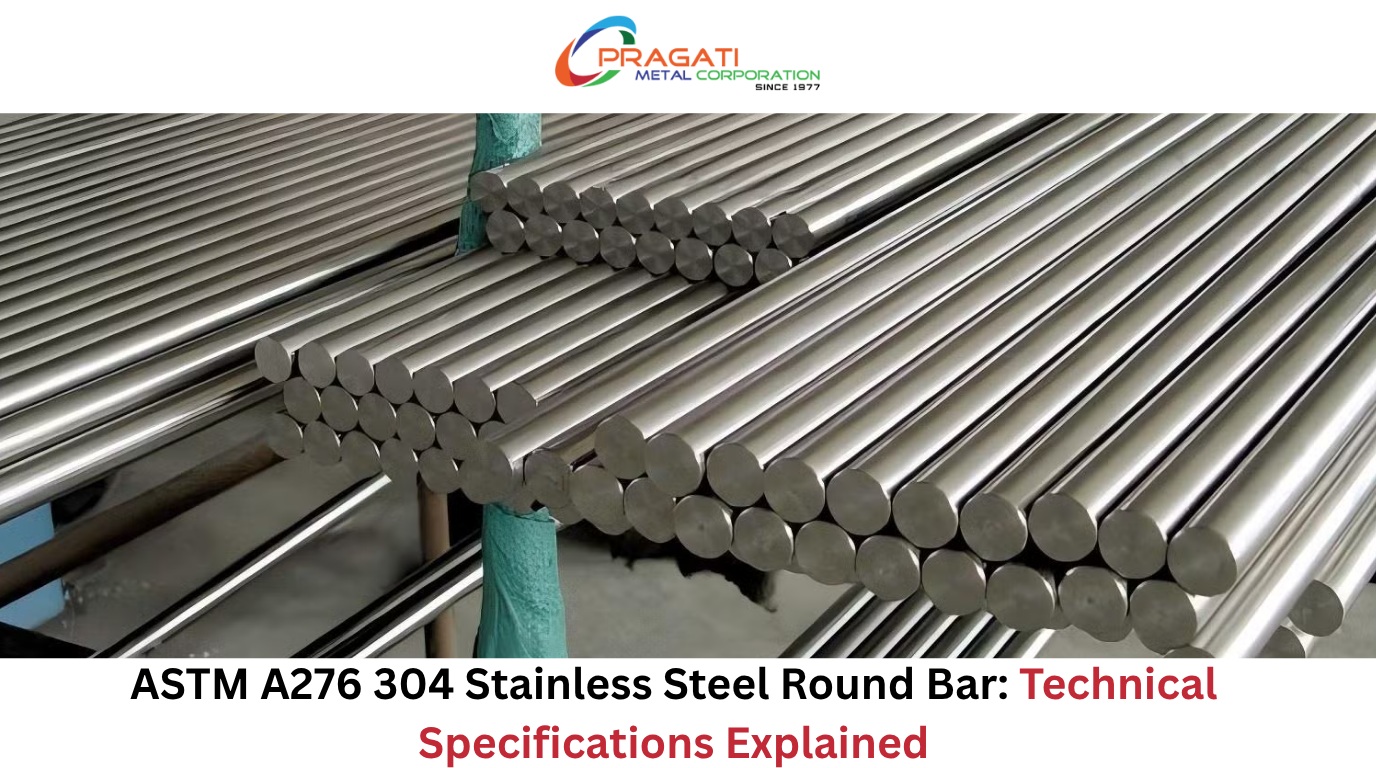
ASTM A276 304 round bar dimensions range from 5 mm to over 400 mm in diameter, with mill tolerances of plus or minus 0.13 mm for smaller sizes. Bars ship in random mill lengths near 6 meters or in cut lengths, with finishes ranging from black hot-rolled to bright cold-drawn. A weight chart for stainless steel round bars helps buyers convert diameter and length into shipping weight before ordering.
Production starts with continuous casting into billets, hot-rolled above 1000°C to form the initial hot rolled SS 304 round bar. Bars needing tighter tolerances undergo cold drawing, producing the cold drawn stainless steel round bar used in precision machining. Annealing restores ductility, and pickling followed by passivation rebuilds the oxide layer, together defining standard stainless steel bar manufacturing for the grade. Quality checks include a tensile test, a hardness test, positive material identification, and ultrasonic testing, with every compliant heat shipping a Mill Test Certificate recording chemistry and mechanical results.
Applications, Forms, and Benefits
Industrial stainless steel bars in Grade 304 serve chemical processing, food and beverage plants, pharmaceutical machinery, marine hardware, construction, and oil and gas fittings, covering most common stainless steel bar uses. The grade also ships as bright bar, black bar, hex bar, square bar, and flat bar: SS 304 bright bar suits precision shafts, SS 304 hex bar fits fasteners, and stainless steel flat bar covers brackets. Advantages include corrosion resistance without coating, weldability without special filler, and a service life measured in decades.
Choosing a Supplier and Certification Requirements
Buyers looking to buy SS 304 round bar should confirm the mill test certificate matches the ordered heat, check that the diameter tolerance suits the machining allowance, and request an EN 10204 3.1 certificate when traceability is required. A manufacturer of stainless steel round bars holding ISO 9001 and PED compliance adds a further layer of documented quality, and an ASTM A276 certified supplier should produce test reports on request, not only after delivery.
Conclusion
Choosing appropriate grades of bar stock relies on matching the particular ASTM A276 specification, Grade 304 chemical composition, dimensional tolerances and certification needs to the application. The buyer who reviews mill certificates confirms the manufacturing route and verifies test results prior to purchase, avoids material that might require reprocessing and obtains material that will be consistent in use and performance.
FAQs
What is ASTM A276?
The ASTM standard covers chemical, mechanical, and dimensional requirements for stainless steel bars in round, square, hex, and flat sections.
Is ASTM A276 304 magnetic?
In the annealed condition, Type 304 is non-magnetic; cold working can introduce a slight magnetic response.
What is the difference between 304 and 316?
Grade 316 adds 2 to 3 percent molybdenum, improving resistance to chloride pitting.
Can ASTM A276 304 be welded?
Yes, using standard TIG, MIG, or stick methods with matching filler wire, without pre-heating in most section sizes.