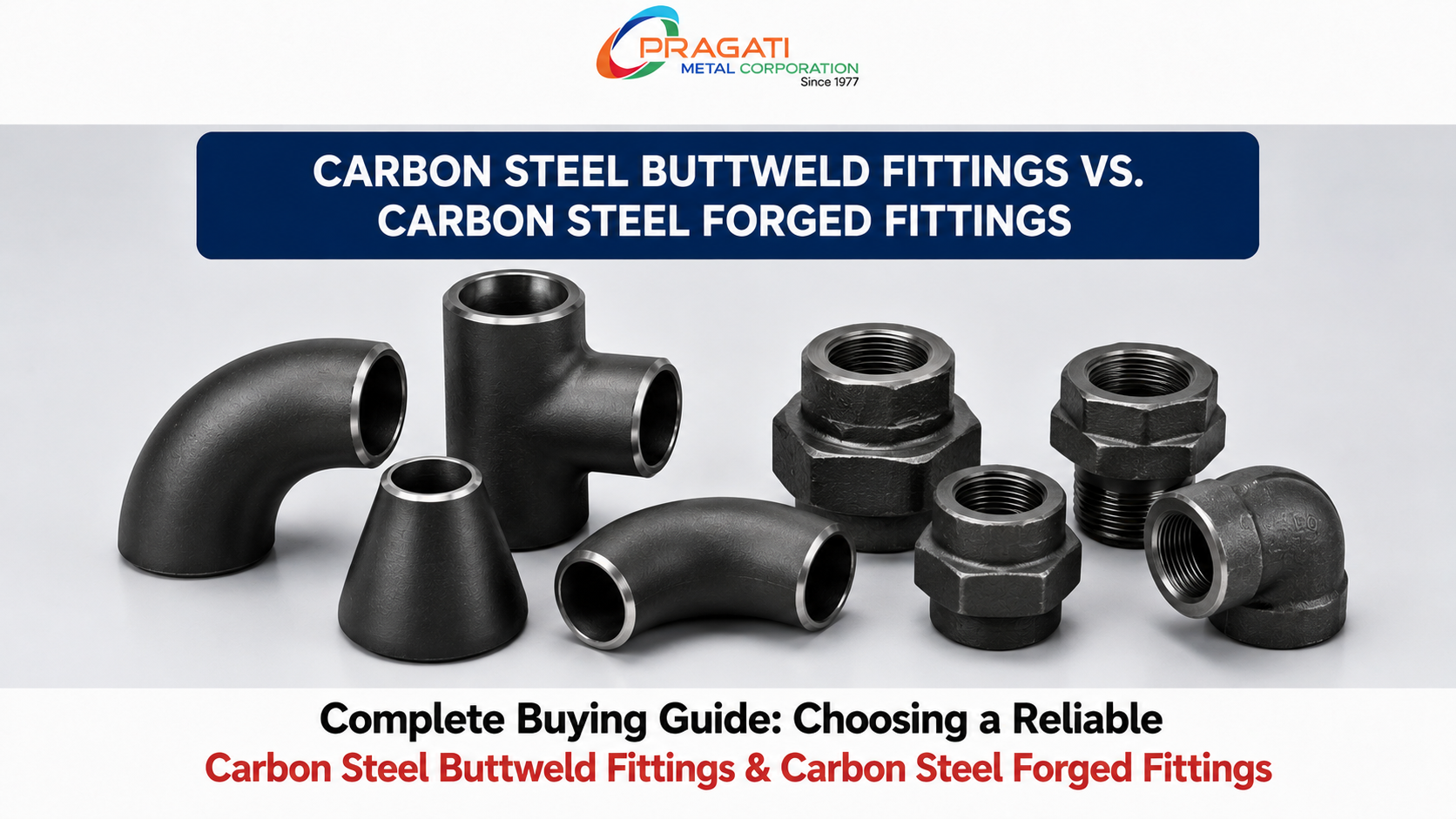
Comparing carbon steel buttweld and forged fittings requires evaluating your specific piping pressure, size, and system requirements. The right choice depends on pipe size, pressure requirements, connection method, installation conditions, design requirements, and total project cost, factors that shift the answer from one project to the next. This guide works through those factors from an engineering and procurement perspective, aiming for a practical selection framework rather than a generic list of differences.
Understanding the Two Fitting Types
Butt weld fittings connect to pipe through a full-penetration weld at the joint, forming a continuous, permanent connection along the pipeline. Forged fittings, by contrast, typically connect through socket weld or threaded methods, offering a different installation approach suited to different piping configurations. That distinction in connection method matters directly during piping-system design, since it shapes fabrication sequence, inspection requirements, and how the finished system gets maintained over its working life.
Buttweld vs. Forged Fittings: Key Differences
| Factor | Carbon Steel Buttweld Fittings | Forged Fittings |
| Connection | Butt welding | Typically socket weld or threaded |
| Typical size considerations | Larger piping systems | Smaller-bore applications are common |
| Installation | Requires welding | Connection method depends on fitting type |
| Pressure requirements | Depends on design/specification | Depends on class, design/specification |
| Space requirements | Consider joint and welding access | Useful where compact connections are required |
| Fabrication | Welding and preparation required | Different installation requirements |
| Cost considerations | Material and welding costs | Fitting and installation costs |
| Selection factors | Size, wall thickness, welding and design | Pressure class, connection and space |
These characteristics aren’t universal rules. Actual suitability always depends on the applicable standard and the specific design conditions a project is working under.
When Carbon Steel Buttweld Fittings Make More Sense
Larger pipe sizes tend to favor butt weld construction, since the welded joint scales well with diameter without introducing the space constraints socket weld or threaded connections can create. Continuous welded piping systems benefit from the uniform joint strength butt welding provides across an entire run. Space and routing requirements matter too: where a layout has room for proper welding access, buttweld fittings integrate cleanly. Smooth internal flow is another consideration, since a properly welded joint avoids the small internal step that some mechanical connections introduce. Project fabrication capabilities play a role as well, since a shop with strong welding capacity gets more value from a buttweld-heavy design than one better equipped for mechanical assembly.
When Forged Fittings May Be the Better Choice
Smaller-bore piping often favors forged fittings, where the compact connection methods available suit tighter dimensions more naturally than a full weld joint. High-pressure service can also favor forged fittings, provided the specified fitting class is verified as appropriate for the actual design pressure. Compact installation areas benefit from forged fittings’ typically smaller footprint at the connection point. Threaded or socket-weld connections offer faster installation in situations where extensive welding isn’t practical or necessary. Projects where installation conditions favor faster, less labor-intensive connections often lean toward forged fittings for exactly that reason. Pressure capability in every case still needs verification against the fitting class, material specification, applicable standard, and actual design conditions before finalizing a decision.
Cost and Installation Considerations
Comparing cost properly means looking at the full project picture, not just which fitting type has a lower purchase price. Welding requirements add labor and time to buttweld installations, along with the need for skilled welders and the inspection or NDT that critical welds often require. Forged fittings can reduce installation time and labor in favorable configurations, but their purchase price per fitting sometimes runs higher for equivalent service conditions. Maintenance considerations matter too: some connection types simplify future disassembly and inspection, while others prioritize a permanent, uninterrupted joint. Weighing purchase price, welding requirements, skilled labor availability, installation time, inspection needs, and maintenance together gives a far more accurate cost picture than comparing per-fitting prices alone.
Which Fitting Should You Choose?
Choose based on:
- Pipe size and wall thickness
- Design pressure and temperature
- Connection method
- Applicable standard/specification
- Available installation space
- Welding and fabrication requirements
- Total installed cost
There’s no universally better fitting between carbon steel buttweld and forged construction. At Pragati Metal Corporation, we look at the piping-system design, operating conditions, applicable standards, and installation requirements before recommending a fitting type. That project-specific approach is more reliable than defaulting to a single preferred connection across every application.