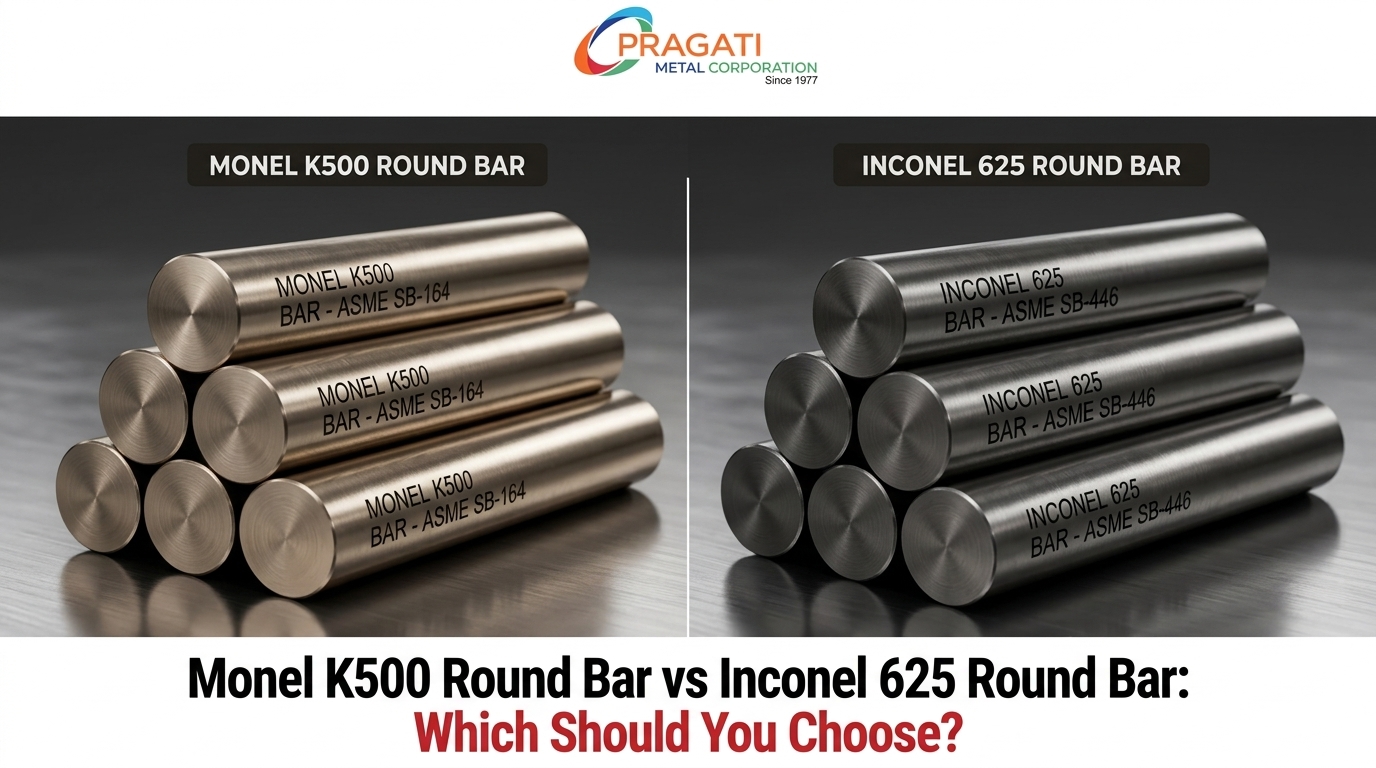
Monel K500 and Inconel 625 are both specified for tough jobs, and both hold up well against corrosion. But they are not the same alloy, and picking the wrong one for a project usually shows up later as a strength issue or a temperature failure. If you are sourcing a Monel K500 Round Bar Supplier for an upcoming order, it helps to know exactly where this alloy fits compared to Inconel 625. Below is a simple comparison so you can match the bar to the job instead of guessing.
Overview of Monel K500 and Inconel 625 Round Bars
Monel K500 Round Bars are made from a nickel-copper base, with aluminium and titanium added in. That addition is what allows precipitation hardening, which is basically a heat treatment step that raises the strength quite a bit above standard Monel 400. The seawater resistance stays intact though. That’s why you see this bar used a lot in propeller shafts, marine fasteners and offshore rig parts.
Inconel 625 Round Bars work differently. This one runs on nickel, chromium and molybdenum, and it holds up under oxidation even when things get heated. Chemical plants, exhaust systems, power stations, all of these throw acids, chlorides and heat cycling at metal parts, and Inconel 625 doesn’t lose its shape or strength under that kind of pressure. That’s the main reason aerospace and process industries keep coming back to it.
Monel K500 vs Inconel 625 – Quick Comparison
Below is a quick comparison between Monel K500 and Inconel 625, based on strength, resistance and more.
| Property | Monel K500 | Inconel 625 |
|---|---|---|
| Base Alloy | Nickel-Copper | Nickel-Chromium |
| Strength | Very High | High |
| Corrosion Resistance | Excellent in seawater | Excellent in aggressive chemicals |
| High-Temperature Performance | Good | Excellent |
| Marine Applications | Excellent | Very Good |
| Common Industries | Marine, Oil & Gas | Aerospace, Chemical Processing, Power Generation |
When Should You Choose Monel K500 Round Bars?
Choose Monel K500 Round Bar, and specifically the ASTM B865 Monel K500 Round Bar grade, if the part needs to be strong and also placed in seawater for years without giving up. Marine shafts and fasteners take a beating from salt spray, and this alloy is built to shrug that off while holding its strength. Oil and gas equipment offshore faces a similar mix, corrosive fluids plus heavy mechanical load, sometimes both at once. UNS N05500 Round Bar stock also resists galling, so pump and valve components made from it tend to last longer under wear. You’ll find it used on offshore platforms, subsea connectors, and propeller systems, basically anywhere a failure would be expensive to fix.
When Should You Choose Inconel 625 Round Bars?
Inconel 625 Round Bar, or UNS N06625 Round Bar if you’re going by the standard designation, is the better fit when heat and aggressive chemicals show up together.
- Heat exchangers in chemical plants deal with corrosive media at high temperatures constantly, and this alloy keeps its mechanical properties without oxidizing or cracking.
- Exhaust systems in marine and industrial engines go through the same kind of stress, repeated heating and cooling, which wears down weaker materials fairly quickly.
- Power generation parts, turbine components, and boiler sections rely on that same stability to avoid unexpected downtime.
- Aerospace parts add one more layer, since weight matters as much as strength when you’re dealing with thermal fatigue at altitude.
Factors to Consider Before Selecting the Right Alloy
Operating Environment
Think about what the part will actually be exposed to, not what it might be exposed to. Seawater needs one kind of resistance, industrial chemicals need another, and high heat needs something else again. Guessing here leads to early failure.
Mechanical Strength Requirements
Look at the load, the wear pattern, and how the part will actually be used day to day. A bolt under constant tension isn’t the same as a static bar sitting in a frame. Don’t skip this step just because it seems obvious.
Corrosion Resistance
Figure out what the part will be sitting in or exposed to, chloride-heavy seawater or something more chemical. Both alloys handle corrosion well, just not the same kind, so this one matters more than people think.
Fabrication and Machining
Machining tolerances, welding steps, how long fabrication will take, all of this needs planning before the material gets ordered. Both alloys behave differently from standard stainless steel on the shop floor.
Which Alloy Offers Better Value?
Price per kilogram reflects only one aspect of the overall cost. Service life, how often the part needs maintenance, the environment it’s sitting in, all of this adds up over time. A bar that’s affordable upfront but fails sooner usually costs more in the end, once you count downtime and replacement. So the better value really depends on the application. Neither alloy is universally better, it comes down to what the part actually has to deal with.
Conclusion
Monel K500 Round Bars work best where strength and seawater resistance both matter, mostly in marine and offshore jobs. Inconel 625 Round Bars are better suited for high heat combined with aggressive chemicals, think chemical plants, power stations, aerospace. Once you know the operating conditions, the choice usually becomes clear on its own. Both alloys earn their place, just not in the same jobs.
Contact Pragati Metal Corporation to select the right Monel K500 Round Bar for your industrial application.