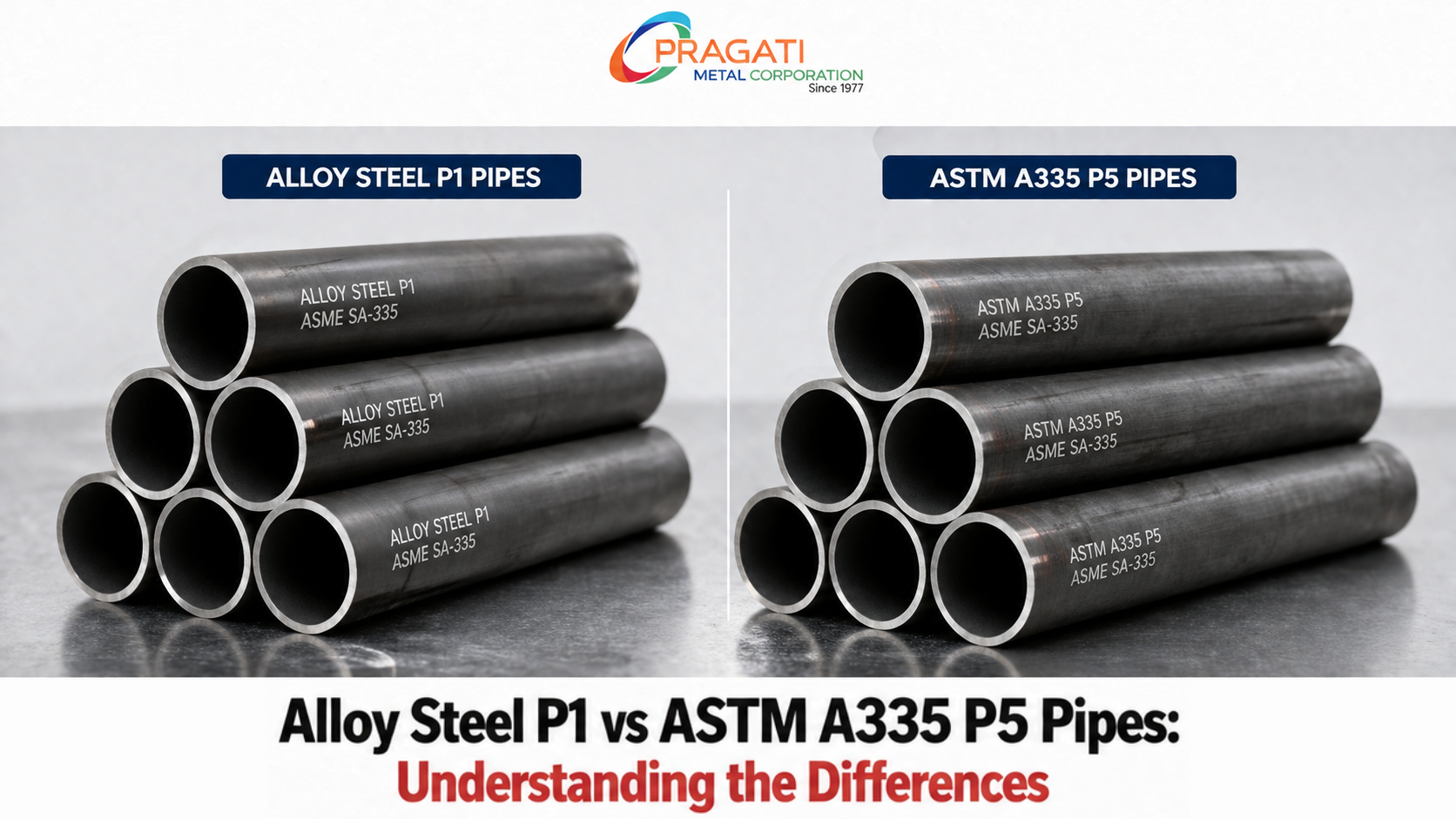
Selecting the right pipe material affects more than the initial purchase. It affects the operating reliability, maintenance frequency, and service life under plant conditions. Engineers often compare alloy steel P1 pipes with ASTM A335 P5 pipes because both are specified for elevated temperature service, yet they are intended for higher temperatures. Understanding where each grade performs best helps avoid unnecessary material costs or premature failures. Working with an experienced alloy steel P1 pipe manufacturer or alloy steel P1 pipe supplier also helps buyers match the material with design conditions instead of selecting a grade based only on familiarity or availability.
Understanding Alloy Steel P1 and ASTM A335 P5 Pipes
P1 is a carbon-molybdenum steel, low on alloying content, used where temperatures stay in a moderate temperature range, and pressure demands are not extreme. It shows up in boiler tubing, general process lines, and steam service where the environment is not particularly corrosive. P5 has increased chromium and molybdenum content, mostly around 5% chromium and 0.5% molybdenum, and gets pulled in for refinery piping, hydro processing units, and furnace tubing where both heat and sulfidic corrosion are part of the job. Procurement teams end up comparing the two because both fall under the ASTM A335 seamless ferritic alloy steel pipe standard, both get used in similar plant areas, and both are frequently quoted side by side on the same enquiry.
Key Differences Between Alloy Steel P1 and ASTM A335 P5 Pipes
The two grades diverge in composition, service temperature, corrosion behavior, strength, and cost, and each of these plays into where a pipe actually gets used.
Material Composition
P1 relies on a modest carbon and molybdenum content, without the chromium addition that defines the higher P grades. This ensures that the the material is easy to weld and formable. P5 brings roughly 5% chromium into the mix along with molybdenum, and that chromium is what changes its behavior under heat and in corrosive gas streams. The composition difference is not large in percentage terms, but it changes what the pipe can handle downstream.
Temperature and Pressure Performance
The P1 pipe holds up reasonably well up to moderate service temperatures, generally suited to conditions below where creep resistance becomes the deciding factor. Once temperatures climb into the range typical of catalytic reforming or hydrocracking units, P1 starts to lose margin. P5 is built for that higher band. Its chromium content improves creep strength at elevated temperatures, which is why it turns up in furnace tubes and high-temperature process lines where P1 would fail.
Corrosion and Oxidation Resistance
Refinery streams carrying sulfur compounds attack plain carbon moly steel faster than they attack chromium-bearing grades. This is where P5 is used, as the chromium forms a more stable oxide layer and slows sulfidation corrosion in hot, Sulphur-heavy service. P1 still performs adequately in cleaner, less aggressive environments, with boiler feed lines and general steam distribution being typical examples, where the corrosion load is lower, and the extra alloying cost is not justified.
Mechanical Strength and Durability
Both grades satisfy the tensile and yield requirements of ASTM A335, but P5 retains its strength more effectively as temperature increases, largely because of its chromium content and resulting microstructure. Within its intended temperature range, P1 is the more appropriate and economical choice, providing a solid service life as long as operating conditions remain within specification. Once either grade is pushed beyond its design limits, however, the gap in remaining life becomes apparent quickly, especially under cyclic thermal loading.
Cost and Project Suitability
P1 is the more economical choice for projects where higher temperature strength and corrosion resistance are not critical. P5 has a higher upfront cost because of its chromium and molybdenum content and more stringent manufacturing requirements. The best material selection depends on the operating temperature, pressure, corrosion environment, project budget, and expected service life.
Choosing the Right Pipe for Your Application
Selection comes down to a handful of practical checks rather than a single rule of thumb.
Operating temperature sets the first boundary. Stay within P1’s rated range, and there is little reason to pay for P5’s added alloying. Cross into the higher band typical of reformers or hydrocracking service, and P5 becomes the safer bet.
Pressure requirements interact directly with temperature and wall thickness. Higher pressure at elevated temperature usually pushes the spec toward better high-temperature strength, which points toward P5.
The type of process media matters as much as the numbers. Clean steam or condensate rarely needs P5’s corrosion resistance. Sulphur-bearing hydrocarbon streams in a refinery unit require a different material selection demands higher corrosion resistance.
The service environment covers ambient exposure and insulation practices too. A pipe run in a corrosive plant atmosphere, even at moderate internal temperatures, may still benefit from P5.
Project specifications often dictate the grade outright. Client standards or engineering codes can set a minimum grade for certain services regardless of calculated conditions.
Long-term maintenance planning should account for inspection intervals. In plants with limited maintenance windows or continuous-process facilities, choosing a grade with better corrosion resistance can extend those intervals and reduce unplanned shutdowns.
Budget and lifecycle cost need weighing over the full service life, not just the purchase order. A cheaper pipe replaced early can cost more across 20 years than the higher alloy option bought once.
Working through an alloy steel seamless pipe spec with these factors in view, rather than defaulting to habit or the lowest quote, tends to produce a more reliable outcome.
Common Applications of Both Pipe Grades
Where each grade lands on a project usually tracks the operating conditions of that specific line rather than the industry label attached to the plant.
Power generation plants use P1 in boiler tubing and steam lines running at moderate heat, while P5 gets specified where flue gas corrosion or higher heat flux is crucial.
Refineries lean on P5 in hydrotreaters and catalytic reformers, where sulfur content and elevated temperature push toward the higher chromium grade. P1 still covers cooler, cleaner sections of the same unit.
Petrochemical plants: P5 in reactor feed and effluent lines, P1 in utility and general process piping.
Boilers specify P1 for standard tube runs and shift to P5 in superheated and reheated sections running hotter.
Heat exchangers in moderate service often run P1 tubing; hot corrosive streams move units up to P5.
Steam lines at typical industrial pressures stay with P1 in most cases.
Process piping carrying non-corrosive fluids at moderate temperature generally specifies P1, with P5 reserved for lines where heat or sulphidic attack pushes past what P1 can handle.
Conclusion
Alloy Steel P1 and ASTM A335 P5 pipes both hold a place in industrial piping systems, and neither one replaces the other across the board. The right choice tracks back to operating temperature, pressure, exposure to corrosive media, and the specific requirements of the project at hand. Working through these factors with an experienced alloy steel P1 pipes manufacturer or alloy steel P1 pipe supplier helps confirm that the grade selected actually matches what the line will face in service, rather than what appears suitable during specification but may not meet actual service conditions.