Copper-nickel alloys have been part of marine and industrial infrastructure for decades. The two most commonly specified grades are 90/10 and 70/30. Both contain copper and nickel as primary elements, with small additions of iron and manganese that improve performance in wet and corrosive environments. They do not rust like carbon steel, and they resist biofouling reasonably well, which makes them practical for seawater-facing systems.
The demand for corrosion resistant materials has steadily grown in offshore platforms, ship building yards, desalination plants and heat exchanger installations. The choice of the right grade from the very beginning directly affects performance, maintenance intervals and the working life of the installation before replacement is necessary.
Businesses sourcing high-quality Copper Nickel 90/10 Round Bar products often prioritize material specifications and application requirements before making their selection.
Understanding the Composition and Characteristics of Copper-Nickel Alloys
What Makes 90/10 Copper-Nickel Different?
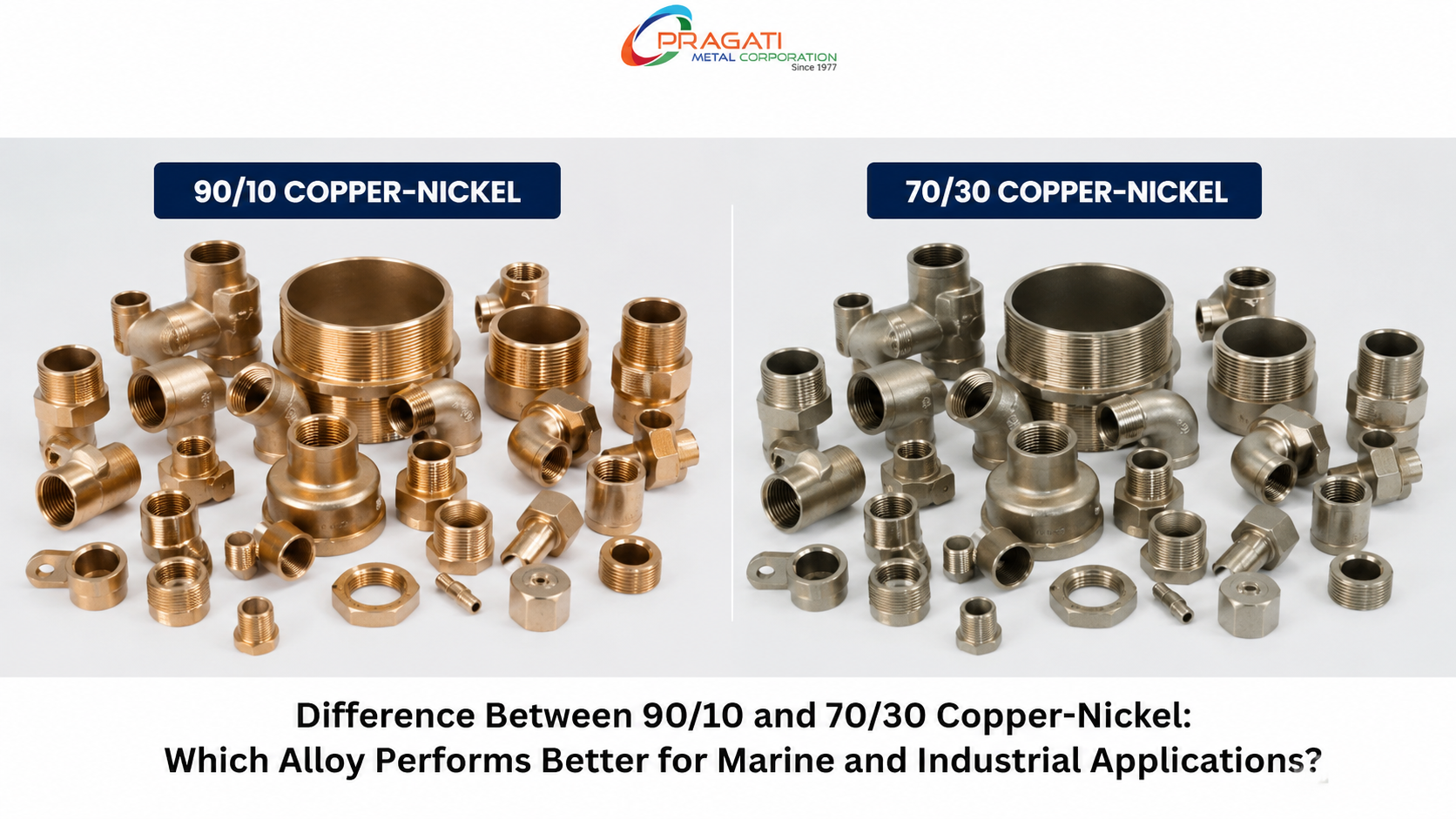
The 90/10 grade contains approximately 90% copper and 10% nickel. Iron is added at around 1.4%, and manganese is present in smaller amounts. Iron helps form a protective film on the surface when exposed to flowing seawater. This grade is more affordable than the other one, more widely available in regular dimensions, and is frequently used in products like Copper Nickel 90/10 Round Bar for industrial fabrication and structural components in marine assemblies.
Understanding 70/30 Copper-Nickel Composition and Performance
The 70/30 grade contains approximately 70% copper and 30% nickel. The higher nickel content raises tensile strength and improves resistance to aggressive marine conditions. It holds its properties better under elevated temperatures and turbulent flow. This grade is generally specified for offshore copper nickel materials in demanding systems where long-term reliability is the priority, not upfront material cost.
Major Differences Between 90/10 and 70/30 Copper-Nickel Alloys
Difference in Chemical Composition
The copper-to-nickel ratio is the most fundamental difference. At 90% versus 70% copper, the composition shift affects strength, corrosion behavior, and fabrication response. Higher nickel content raises the alloy’s mechanical limits and improves resistance to stress corrosion cracking. Iron and manganese additions are present in both grades, adjusted for the base composition.
Corrosion Resistance in Seawater Environments
Both alloys form a protective oxide film in seawater that limits corrosion. In clean, moderate‑flow seawater, 90/10 performs well, but 70/30 resists erosion‑corrosion better at higher velocities or harsher conditions. Copper’s toxicity to marine life also helps reduce biofouling, maintaining efficiency and preventing under‑deposit corrosion.
Strength and Mechanical Properties Comparison
Tensile strength for 90/10 typically falls in the 300 to 380 MPa range. The 70/30 grade comes in higher, around 380 to 450 MPa depending on temper and product form. For systems handling higher pressure or requiring thinner walls, 70/30 allows tighter design margins. Resistance to erosion under high flow rates is also better in 70/30, making it the preferred choice where the 90/10 grade would wear faster.
Performance Under Marine and Offshore Conditions
In rough, fast-moving seawater, 70/30 performs better than 90/10. Its higher nickel content resists impingement attack from high‑velocity, particle‑laden water. Naval ships and offshore platforms typically use 70/30 for critical seawater piping. For less demanding commercial marine systems, 90/10 remains the long‑standing, cost‑effective standard choice.
Cost and Material Availability Considerations
The higher nickel content in 70/30 adds to material cost, and availability in some dimensions can be more limited. For projects with moderate operating conditions and tight budgets, 90/10 delivers acceptable performance at lower cost. That said, specifying 90/10 purely to cut cost in applications that need 70/30 usually increases maintenance expenditure and shortens service life.
Fabrication, Welding, and Maintenance Requirements
Both alloys are easy to form and machine using standard methods. They can also be welded with suitable filler metals. For 70/30, heat input and post‑weld treatment need extra care. Compared with carbon steel, maintenance is low, but harsh conditions require closer wall-thickness checks, especially in fast-flowing 90/10 systems.
Comparison Table Between 90/10 and 70/30 Copper-Nickel Alloys
The comparison of 90/10 copper nickel alloys with 70/30 is listed in the table given below.
|
Property |
90/10 Copper-Nickel |
70/30 Copper-Nickel |
| Copper Content | 90% | 70% |
| Nickel Content | 10% | 30% |
| Corrosion Resistance | Very Good | Excellent |
| Strength | Moderate | Higher |
| Cost | More economical | Higher cost |
| Seawater Performance | Suitable for standard marine use | Suitable for harsh marine conditions |
| Common Industries | Shipbuilding, condensers | Offshore, naval, desalination |
| Typical Products | Copper nickel 90 10 pipe, cupro nickel round bars | High-performance marine systems |
Common Industrial Applications of 90/10 and 70/30 Copper-Nickel Alloys
Applications of 90/10 Copper-Nickel Materials
The 90/10 grade is used in condenser systems, shell-and-tube heat exchangers, and seawater piping on commercial vessels. Copper nickel 90 10 pipe is a standard material for cooling lines and fire suppression systems in coastal and commercial marine applications. It is cost-effective, easy to fabricate, and carries a long service record in these environments.
Applications of 70/30 Copper-Nickel Materials
Naval vessels and offshore oil and gas platforms specify 70/30 for critical seawater systems. Desalination plants operating at high capacity use it in key process sections. High-performance seawater pipelines in aggressive conditions, along with industrial processing environments where chemical exposure and mechanical stress combine, are where the 70/30 grade is regularly specified.
How to Select the Right Copper-Nickel Grade for Your Project
Operating temperature, water velocity, and flow conditions are the main technical factors. If flow rates are high and the system includes bends or direction changes, 70/30 is the safer choice to avoid erosion-corrosion. When the application is high pressure, turbulent flow and aggressive seawater, a copper nickel alloy comparison is critical for procurement teams. In these cases the extra cost of 70/30 is normally compensated by longer service life and less frequent maintenance.
About the Supplier
Trusted Source for Copper Nickel 90/10 Round Bar Products
Pragati Metal Corporation, established in 1977 and based in Mumbai, India, has over 40 years of experience manufacturing and supplying ferrous and non-ferrous metal products. The Company is certified according to ISO 9001:2015, ISO 14001:2015 and ISO 18001:2007. Copper Nickel 90/10 Round Bar Products are available in a variety of sizes and grades to meet the needs of the local and global markets. We stock cupro nickel round bars for immediate project requirements. We serve the marine, power generation, oil and gas, petrochemical and fabricating industries. The company also supplies Inconel 600 Tubes and serves as a recognized Inconel 600 tubes manufacturer across multiple alloy families including Stainless Steel, Duplex Steel, Nickel Alloys, Monel, Hastelloy, and Titanium.
Conclusion
The difference between 90/10 and 70/30 copper-nickel comes down to nickel content, and that shift has direct consequences for strength, corrosion resistance, and performance in demanding conditions. The 90/10 grade suits standard seawater systems and commercial marine applications. The 70/30 grade belongs in offshore, naval, and high-intensity industrial environments. Application environment, pressure requirements, flow velocity, and long-term maintenance budget should drive the selection. For specifications, pricing, or product availability on Copper Nickel 90/10 Round Bar or related copper-nickel products, contact Pragati Metal Corporation for technical guidance.